

Svart Ridå didn’t start with a plan to form a band. It began with two six-year-olds who refused to accept the roles in someone else’s game.
At a birthday party just over twenty years ago, the birthday child was supposed to take center stage. But when the game didn’t go the way Moa Swanström Borenberg and Tuva Gustavsson wanted, they left the others and went upstairs to play by themselves.
“If I don’t get to be the princess, I’m going upstairs to play up there instead.”
They laugh at the memory. Six months later, they started at the same school. They’ve been inseparable ever since.
“From the very first moment, there was just an attraction to each other. It’s hard to put into words. You recognize an energy and realize you’re meant to be together.”
Music early on became its own language in their friendship. They introduced each other to new artists, shared their listening habits, and let each other’s taste slowly become part of their own. They have shaped each other for so long that today it’s hard to tell where one ends and the other begins.
In high school, they played in other lineups in Karlskrona. It gave them their first experiences of being on stage and being part of a band, but Svart Ridå would become something else. When they later left Blekinge for Malmö, the playing field changed too.
“In a small town, you can be a big fish in a small pond. When you move to Malmö, you have to start working your way up again. Now I guess it’s Sweden—and then the world.”
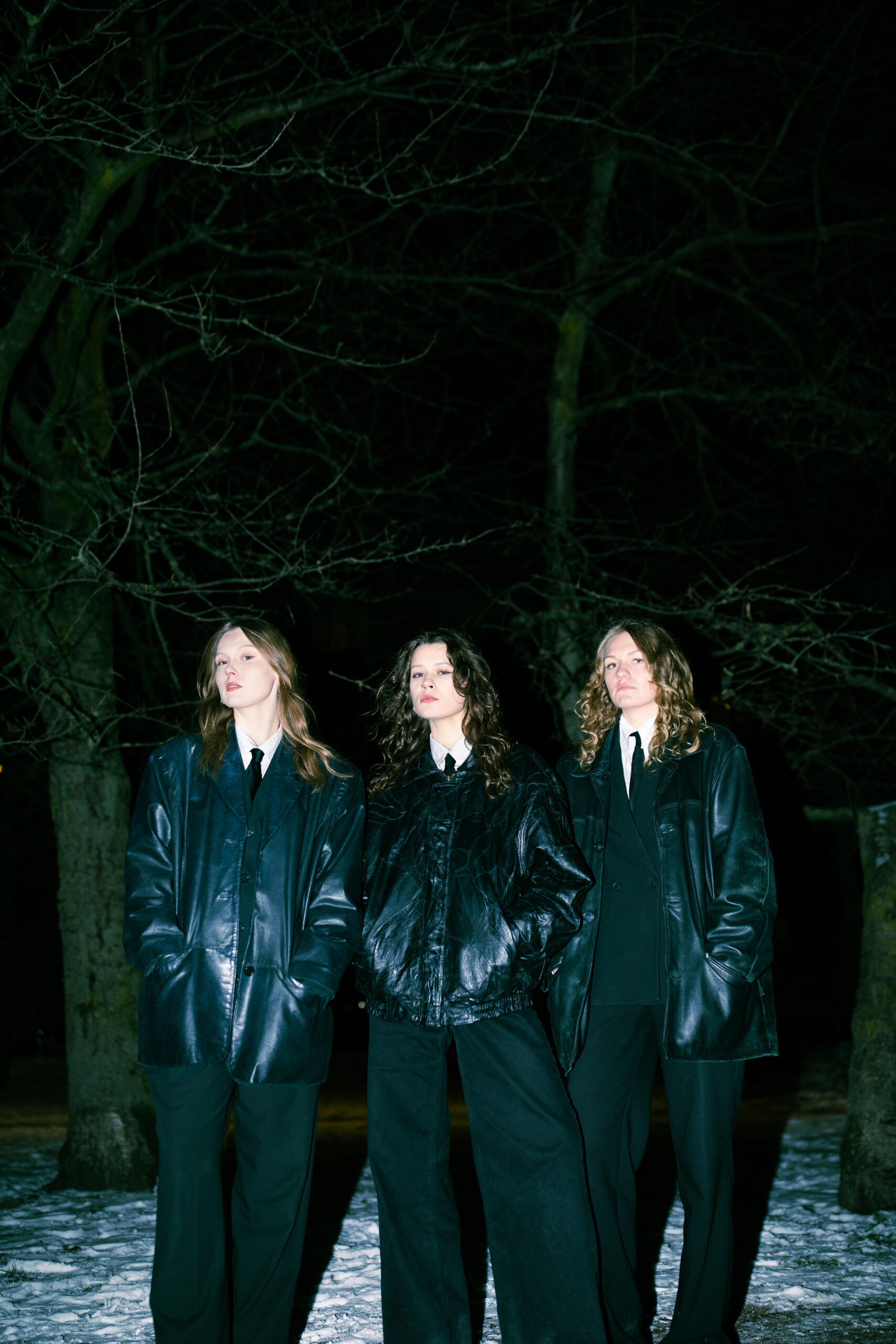
It sounds confident, but also entirely in line with Svart Ridå’s stage concept. They don’t step onto the stage as three private individuals. The costumes, the movements, and the seriousness form a collective expression where the band itself stands ahead of the individuals.
“From the beginning, there was no frontperson and no personalities that were supposed to be at the center. The music was meant to be at the center. We’re some kind of vessel for it to pass through.”
Behind that collective figure, however, lie three deeply personal paths into music.
For Moa, it started with a guitar in an attic. Her father, who played blues, died when she was four years old. A few years later, she found one of his instruments. Her mother told her the guitar would be hers if she learned how to play.
“Because my dad died when I was so young, music became my way of staying close to him. I started playing a lot of blues. We don’t play blues now, but I still carry that style with me.”
The guitar is both an instrument and a connection to the past. Her memories from those earliest years are uncertain—sometimes it’s hard to know what you actually remember versus what you’ve constructed around photographs and stories—but through the music, her father still feels present.
When drummer Kajsa Westergren joined, Moa and Tuva already shared a nearly lifelong history. That could have made the transition from duo to trio complicated. Instead, it felt natural. Kajsa and Tuva had attended the same folk high school and had mutual friends.
“It probably should have been hard to step into such a close friendship. But it felt very right and very easy straight away.”
It’s only when they talk about their interplay that it becomes clear how completely the trio now functions as a single unit. Kajsa sometimes leans slightly ahead in her drumming, while Tuva’s bass might rest a bit behind. The tension between them creates movement. No one leads alone, and no one always follows. When a song needs to stretch out or come to a sudden halt, they feel it together.
“We’ve become so comfortable in our ways of playing that it just comes naturally. We feel it the same way. That’s our chemistry.”
That chemistry has also enabled them to build a bigger sound than a trio format might suggest. The songs are written and arranged in the rehearsal room, where the core structure has to work with guitar, bass, and drums. In the studio, however, they allow themselves to layer more guitars, effects, and soundscapes without trying to recreate exactly what three people can do on stage.
“We always write the music in the rehearsal room and arrange it for how it should work live. When we go into the studio, we don’t have to limit ourselves to how we’ll sound on stage later. Then we can layer on as much as we want.”
On record, the music becomes layered and spatial. Live, it becomes more direct, harder, and more punk. They don’t view the difference as a compromise. On the contrary, it’s a way to let both formats be themselves.
“Live music has to be allowed to be live. That’s why we never want backing tracks. It shouldn’t sound exactly like on the record.”
When they talk about influences, two seemingly opposite ideals recur. Jeff Beck represents delicate, expressive guitar playing. The Hives represent the punch in the face, the swagger, and the conviction that a stage is meant to be conquered.
“We want to be expressive and touch people, while at the same time really delivering and showing everything we are. You shouldn’t make apologies on stage.”
And then, of course, there is Kent. For Moa and Tuva, the band was not just a musical reference, but an emotional refuge growing up. What they carried with them above all is the ability to touch listeners—just as much through the melodies as through the poetry in the lyrics.
They resist the idea of actively trying to be successors, however. When you’ve listened to something that intensely for so many years, it seeps into your bones, they explain. The similarities arise subconsciously, not through a calculated plan to recreate a specific sound.
At the same time, Kajsa’s current listening habits lie far from expected Swedish indie rock. She mentions hyperpop and hard electronic acts. Tuva listens broadly, but notes that cheerful bangers are rare. What they have in common is rather the edge, the darkness, and the feeling that something is at stake.
Svart Ridå writes in Swedish because the language is closest to them. But that proximity also makes the work harder. In your native tongue, you immediately hear when a phrasing doesn’t feel genuine, much like bad acting in a Swedish film.
“It’s not always easier to write in Swedish, but it becomes more honest and more direct. It sits closer to who you are.”
That honesty also characterizes the band’s second album, APONIA. The word means the absence of pain, but for them, it holds two opposite possibilities: the relief following long-lasting suffering, and the terrifying numbness of feeling nothing at all.
They view the album as a continuation of their self-titled debut. Where the first record descended into the darkness, APONIA attempts to find a way out. The true release only arrives in the final track, “När smärtan lämnar kroppen” (When the Pain Leaves the Body).
“That’s where the shift happens. That’s where the catharsis occurs.”
Then comes “I ögats ljus” (In the Light of the Eye), outside the album, almost as the next step after the pain has left the body.
But the light doesn’t mean the inner darkness vanishes. In “Verkligheten har jag här för mig själv” (I Have Reality Here to Myself), there’s an almost defiant celebration of shutting oneself in. Paradoxically, their private space has grown larger as their audience has grown.
After concerts, euphoria doesn’t always follow. On tour, they’re still together and anchored in the world of the music. The emptiness can arrive only when they return home and that intense life is suddenly replaced by everyday routine.
“After you’ve been out playing, it can turn into an identity thing: What does my life mean now when I’m not doing music? That’s when the emptiness can set in.”
On APONIA, there are also two instrumental pieces, “Idiot” and “Nattfjäril” (Moth). There, the band doesn’t need to explain anything. The music is allowed to carry the emotion without words dictating how the listener should interpret it.
“Instrumental music can be incredibly powerful when you want to convey something. Then it’s more about feeling than a narrative. The listener can create their own meaning entirely.”
Even when the songs have lyrics, the music comes first. Chords, rhythm, and melody emerge in the rehearsal space. The words are written last, once the song has already begun to reveal what it wants to be. Deciding on the subject matter in advance would feel limiting.
“It’s like the music gets to tell us what the song is about, rather than us deciding it beforehand.”
The album title itself became one such turning point. Once the word APONIA took on its meaning, it unlocked the entire record. “När smärtan lämnar kroppen” came almost immediately and, in a sense, wrote itself.
In the newer songs, the perspective has shifted toward heritage, family, and the bonds between people. “Förfäder” (Ancestors) is an unusually direct tribute to those who mattered, those who have passed away or are fading. “Blodsband” (Bloodlines) is more unexpected. It isn’t primarily about biological kin, but about the three of them.
“We aren’t related, but we’re flesh and blood somehow anyway. We’re like a family.”
On stage, a fourth figure has also appeared: the doll Eva. She is human in shape but stands outside humanity at the same time. Through her gaze, the band can observe both human beauty and our capacity for violence—how we love each other and how we kill each other.
In an era defined by artificial intelligence and increasingly blurred boundaries between human and machine, it became enticing to create someone who resembles us without being one of us.
“We use her as someone who can mirror the world with a more objective eye. She can see both the beauty and the horror in humanity.”
It’s a long way from the birthday party in Ronneby to a doll observing humanity from the stage. Yet the same impulse remains. Two children leave a game where someone else dictated the roles and build a space of their own. Over twenty years later, they are still doing the exact same thing—now alongside Kajsa, and before a growing audience.
Svart Ridå is therefore less about three personalities standing front and center than about what emerges between them: the music, the friendship, and the shared body that the band has become.
Not related.
But flesh and blood.